



Selecting the Right Conveyor Belt Cleaner
Maintaining a clean conveyor belt is not only essential for operational efficiency but also critical for workplace safety. Residues that adhere to the belt can cause material accumulation and loss, equipment damage, and unsafe working conditions. Conveyor belt cleaners are therefore indispensable across a variety of industries, including mining, quarrying, food processing and logistics. This guide explores the different types of conveyor belt cleaners, their advantages, key selection criteria to choose the right one for you, as well as best practices for conveyor safety and maintenance.
TABLE OF CONTENT
- Top 5 Issues Solved Thanks to Conveyor Belt Cleaning
- Which Type of Belt Cleaner is Right for You?
- Key Parameters to Consider to Choose the Right Belt Cleaner for You
- Discover MLT’s Belt Cleaning Solutions
- Safety and Maintenance Guidelines
TOP 5 ISSUES SOLVED THANKS TO CONVEYOR BELT CLEANING
Conveyor belts are continuously exposed to the passage of materials — whether dry, wet, or sticky — that tend to adhere to their surface. Over time, these residues accumulate and can cause a range of operational issues. The most effective way to prevent them is to install conveyor belt cleaning systems.
1. CARRYBACK
Residues, dust, and spillage can accumulate on the belt surface, rollers, or pulleys. These deposits can clog transfer points, cause material loss and reduce the overall efficiency of conveyor systems. Properly designed and positioned, belt cleaners continuously remove carryback and residues at the head pulley and beneath the conveyor, keeping the belt and its components clean during operation.
2. EXCESSIVE WEAR ON BELTS AND COMPONENTS
Material that remains stuck accelerates wear on the belt and its surrounding components. In severe environments, such abrasion can damage the belt carcass and significantly reduce its service life. By removing these particles before they circulate back into the system, belt cleaners increase the overall lifespan of the system.
3. CONVEYOR MALFUNCTIONS AND DOWNTIME
When residues accumulate, they can alter belt tracking and tension. This can lead to belt misalignment, slippage, or system overload, which increases the likelihood of stoppages or emergency shutdowns. By eliminating excess buildup, scrapers help maintain optimal operating conditions, reducing the frequency of malfunctions and unplanned downtime.
4. HIGH MAINTENANCE COSTS
Without cleaning systems, operators must regularly intervene to remove accumulated materials. These manual cleanups are time-consuming and require recurrent shutdowns. Excess buildup can also force emergency interventions when blockages occur. Cleaning systems contribute to the maintenance and protection of all conveyor components. Maintenance becomes more predictable, interventions, repairs and replacements less frequent, and their associated costs are reduced.
5. UNSAFE WORKING CONDITIONS
Carryback creates multiple safety risks: obstructed walkways, slipping hazards, difficult access to equipment, air pollution... In dry environments, dust generated by carryback may contribute to poor air quality and respiratory issues, while in wet environments buildup can create slippery areas. Maintaining clean conveyor belts helps keep the area around the conveyor accessible, limit airborne dust emissions and contribute to a safer working environment.
WHICH TYPE OF BELT CLEANER IS RIGHT FOR YOU?
There are 3 main types of conveyor belt cleaning solutions, each adapted to a specific use and position on the conveyor:
Preparing a belt for splicing may also involve additional tools:
| Type of Cleaner | How It Works | Key Advantages |
|---|---|---|
|
Primary Conveyor Belt Cleaner |
Installed on the head pulley, primary belt cleaners eliminate bulk material from the belt surface, ensuring pre-cleaning and retaining material in the flow. |
|
|
Secondary Conveyor Belt Cleaner |
Positioned beneath the conveyor, secondary belt cleaners provide additional cleaning. They capture residual material missed by the primary scraper, protecting both the belt and equipment. |
|
|
V-Plough |
Located on the inside of the belt, V-ploughs clean the inner surface of the belt and protect the foot drum from impacts. |
|
ADDITIONAL NOTES ON BLADE CHARACTERISTICS AND COMPATIBILITY
Conveyor belt cleaner blades are typically available in two materials:
- Polyurethane blades offer gentle cleaning for belts in poor conditions, including those with pronounced surface roughness
- Tungsten blades provide enhanced cleaning efficiency and greater resistance to aggressive environments
Blade scraping widths vary significantly, ranging from 400 mm up to 2 000 mm or more, to suit different conveyor belt sizes.
In addition, belt cleaners are designed to accommodate a wide range of head drum diameters, typically from 200–400 mm up to 850–1050 mm and thereby ensuring correct blade pressure and contact with the belt.
MAKE THE RIGHT CHOICE: KEY PARAMETERS TO CONSIDER TO CHOOSE THE RIGHT BELT CLEANER FOR YOU
In order to determine the best conveyor belt cleaner for your installations, several technical parameters must be considered. Below, we outline the main factors to guide your selection:
1. TYPE OF MATERIAL CONVEYED
The nature of the material transported has a direct impact on the performance of belt cleaners. Dry, dusty, or abrasive materials may require more robust blade materials such as tungsten to maintain effective cleaning, while sticky or wet substances may benefit from polyurethane blades that prevent clogging.
2. CONVEYOR ENVIRONMENT
Environmental conditions also play a crucial role in the selection of a belt cleaner. High temperatures (e.g., steam exposure above 60°C) or chemically aggressive environments can degrade blades not designed for these conditions. Choosing blades and components rated for your operating temperature and chemical exposure ensures reliable cleaning performance and extends service life.
3. TYPE OF BELT
The configuration of the belt—reversible or non-reversible—affects its compatibility with the belt cleaning system, especially for the selection of secondary belt cleaners.
4. BELT SPEED AND WIDTH
Higher belt speeds place greater mechanical demands on cleaners. Inadequately rated conveyor belt cleaners can vibrate, deflect, or suffer frame deformation, reducing blade-to-belt contact and cleaning performance. Similarly, blade width must correspond closely to the belt width and material path to ensure even cleaning and prevent uneven wear, such as the “smiling blade” effect.
5. DESIRED SCRAPER POSITIONING
The location of the belt cleaner — on the head pulley, under the conveyor or on the inside of the belt—determines its function and compatibility with your installation. Primary conveyor belt cleaners handle the bulk of material carryback, while secondary conveyor belt cleaners provide additional cleaning beneath the conveyor.
6. BLADE MATERIAL
Blade selection—polyurethane or tungsten—must match both the material carried and the environmental conditions. Polyurethane blades are suitable for gentle cleaning of worn belts or non-abrasive materials, while tungsten blades provide superior resistance in abrasive or harsh conditions, maintaining consistent cleaning performance and prolonging blade life.
BOOST YOUR EFFICIENCY: DISCOVER MLT’S BELT CLEANING SOLUTIONS
| Product |
Type of Cleaner |
Type of Blade |
How It Works |
|---|---|---|---|
|
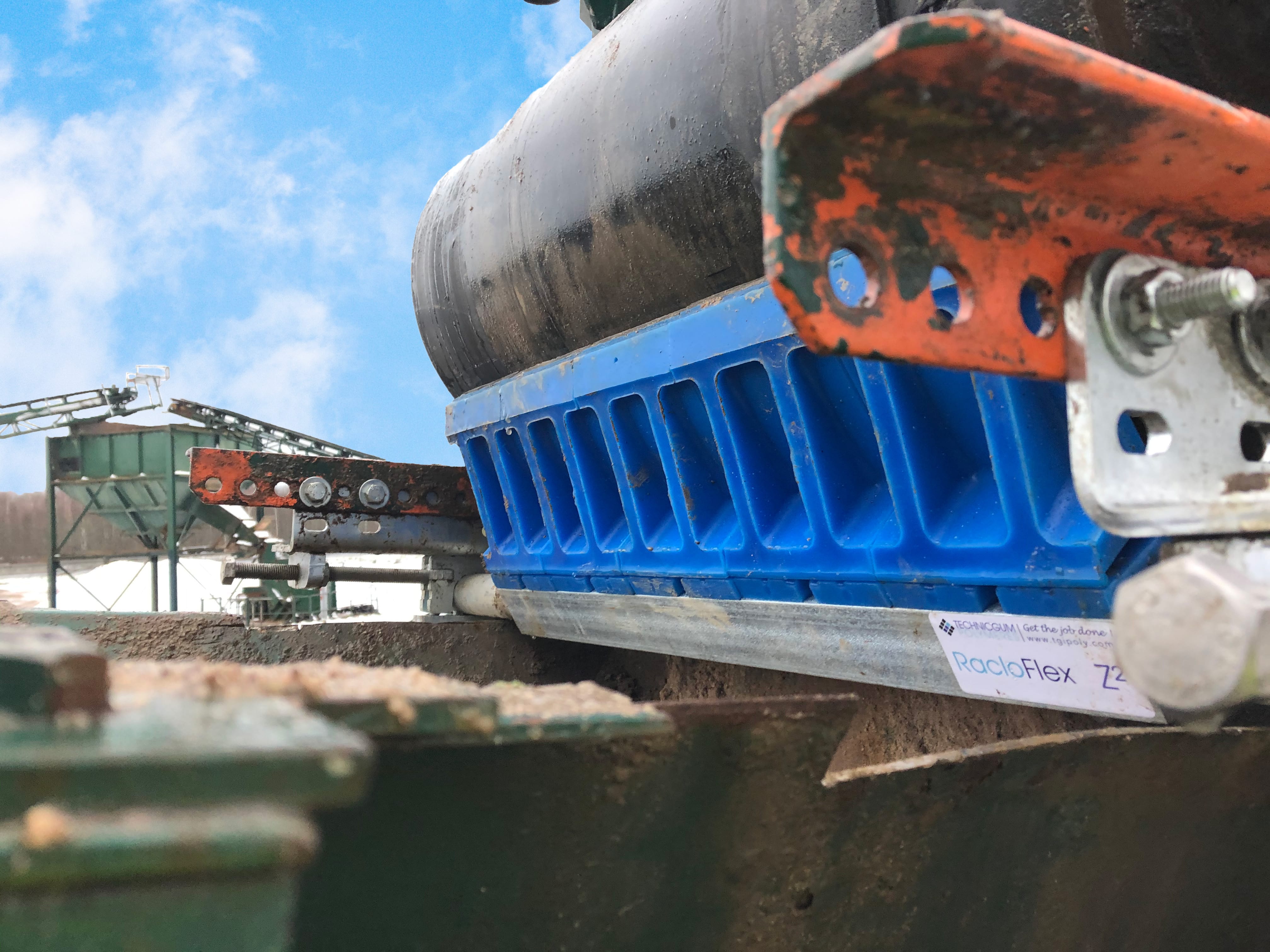
RACLOFLEX™ Z² HD |
Primary |
Polyurethane |
Designed for heavy-duty applications, this primary scraper removes bulk material from the belt surface at the head pulley. The system automatically realigns blades for central wear compensation and adapts to belt wear and deformation. |
|
RACLOFLEX™ NT & HD |
Primary | Tungsten |
Multi-blade scraper with each blade supported by an independent shock-absorbing block. Its blades can be individually realigned to compensate for uneven wear. It is equipped with bi-hardened rubber technology and stainless-steel deflectors for robustness and flexibility. |
|
RACLOFLEX™ SW & HD |
Secondary | Tungsten |
Self-compensating blade system with two internal levers converting external lateral pressure into central pressure. This self-compensating system automatically adapts to wear, ensuring maximum efficiency and service life. Designed for non-reversible, one-way belts. |
|
RACLOFLEX™ SW Metal |
Secondary | Tungsten |
This secondary scraper was designed for high temperatures. Each blade can be independently replaced and adjusted to compensate for faster central wear or belt concavity/convexity. |
|
RACLOFLEX™ N & HD |
Secondary | Tungsten |
Multi-blade secondary scraper with each blade supported by a shock-absorbing block, adjustable to compensate for uneven wear. Integrating bi-hard rubber technology, it is more robust than most equivalent models. |
|
RACLOFLEX™ VP |
V-Plough |
Polyurethane | Installed inside the belt, this pilot segmented scraper protects the foot drum from impact and cleans the inside of the band. It applies reduced scraping pressure and provides simplified modular replacement. |
SAFETY AND MAINTENANCE GUIDELINES
SAFETY REQUIREMENTS
Safety is paramount when working with conveyor belt cleaners. Always ensure the conveyor is stopped and locked out before performing any maintenance or handling. Make sure to apply the Lockout, Tagout, Blockout, and Test (LOTOBOTO) procedures and verify that unintentional restarts are prevented. Protective covers should be installed to restrict access to hazardous areas and minimize risk.
Personal Protective Equipment (PPE) is mandatory, including:
- Safety shoes
- Gloves
- Goggles
- Hearing protection
- Hard hats
- Harness if necessary
MAINTENANCE SCHEDULE
Regular maintenance is essential to prolong the life of your scrapers and maintain cleaning efficiency. Adhering to the routine outlined below minimizes downtime, reduces wear on equipment, and ensures safe and efficient conveyor systems.
Every week
- Check dirt and wear on the scrapers
- Clean the inner and outer blades with a brush or spatula and replace the blades if needed
- Check blade tension and retighten if needed
Every two weeks
- Inspect all bolts and mounting hardware for tightness. Retighten as required to maintain secure installation.
Our Expertise at Your Service
Selecting the right conveyor belt cleaning equipment is key to improve efficiency, safety, and equipment longevity. At MLT, we guide you through the process of choosing the optimal cleaning system tailored to your conveyor type, material, and operational requirements.
Our services also include on-site installation, system audits, and hands-on training, ensuring your teams know how to operate and maintain the solution effectively.